
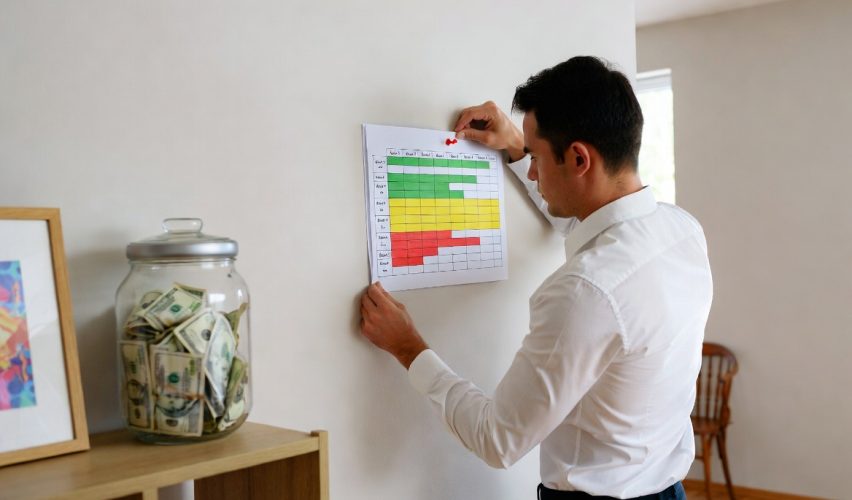
Most savings challenges fail because they start too aggressively or lack structure. This 30-day challenge uses proven behavioral science to build your savings muscle gradually — and you will have $500 to $1,000 saved by the end without feeling deprived.
Why Most Savings Challenges Fail
The classic “save $1 on day 1, $2 on day 2, $3 on day 3” challenge sounds easy at first but requires you to save $30 on day 30 and $465 total. By week three, most people have either fallen behind or given up entirely. The increasing daily commitment creates unsustainable pressure.
Another common failure is the “no-spend challenge” where you try to spend nothing for an entire month. This is unrealistic for most people and often leads to a binge-spending rebound at the end. Deprivation-based challenges rarely create lasting habits because they fight against human nature rather than working with it.
The challenge below is different. It combines small daily savings actions with specific spending substitutions. Each day has a concrete task that takes five minutes or less. The savings accumulate naturally without requiring willpower or sacrifice — just awareness and small adjustments.
Week 1: The Awareness Week (Days 1-7)
Day 1: Track every purchase today. Write down everything you spend, no matter how small. The act of recording creates immediate awareness. Most people discover $5 to $15 in spending they would not have noticed. Transfer $10 to savings.
Day 2: Find and cancel one unused subscription. Check your bank statement for recurring charges. Cancel anything you have not used in the past two weeks — you can always resubscribe. Transfer the monthly cost to savings. Average savings: $10 to $15.
Day 3: Pack lunch instead of buying. A homemade lunch costs $2 to $4 versus $10 to $15 for a bought lunch. Transfer the difference ($8 to $12) to savings.
Day 4: Make coffee at home. Skip the coffee shop and brew your own. Transfer $5 to savings. This is the classic savings tip because it works — $5 per day is $150 per month.
Day 5: Conduct a pantry inventory. Plan tomorrow’s meals from what you already have. Skip the grocery run. Transfer $15 to savings for the groceries you did not buy.
Day 6: Call one service provider and ask for a discount. Call your internet, phone, or insurance company. Say you are considering switching and ask about retention offers. Average savings: $10 to $30 per month. Transfer $15 to savings.
Day 7: No-spend day. Spend $0 today. Cook from what you have, use free entertainment, and stay out of stores. Transfer $20 to savings for what you normally would have spent.
Week 2: The Substitution Week (Days 8-14)
Day 8: Use a free entertainment option. Library, park, free community event, hiking trail, or a game night at home instead of paid entertainment. Transfer $15 to savings.
Day 9: Buy store brand instead of name brand on your next shopping trip. Compare unit prices and switch to store brands for at least five items. Transfer $8 to savings.
Day 10: Walk or bike instead of driving for one errand. Save on gas and get exercise. Transfer $5 to savings.
Day 11: Meal prep one batch recipe for the week. A big pot of soup, chili, or a casserole that covers three to four meals eliminates takeout temptation. Transfer $20 to savings for the takeout you avoided.
Day 12: Use a cashback app for today’s purchases. Download Ibotta, Rakuten, or Fetch Rewards and earn money back on things you buy anyway. Transfer $5 to savings.
Day 13: Implement a 24-hour rule. For any non-essential purchase today, wait 24 hours before buying. Most impulse purchases feel unnecessary the next day. Transfer $15 to savings for what you did not buy.
Day 14: No-spend day. Second no-spend day. These get easier with practice. Transfer $20 to savings.
- Week 1 savings target: $83-97 (awareness actions)
- Week 2 savings target: $88 (substitutions)
- Week 3 savings target: $113 (optimization)
- Week 4 savings target: $128-143 (automation)
- Total 30-day target: $500+ (often reaches $700-1,000)
Week 3: The Optimization Week (Days 15-21)
Day 15: Compare prices on your three most-purchased grocery items at different stores. You might find that Aldi is $3 cheaper per item than your regular store. Transfer $10 to savings.
Day 16: Sell something you no longer need. List one item on Facebook Marketplace, eBay, or Poshmark. Clothing, electronics, furniture, and kitchen gadgets are easy sellers. Transfer all proceeds to savings.
Day 17: Review your utility usage. Adjust your thermostat by 2 degrees, unplug devices not in use, and switch to cold water laundry. Transfer $10 to savings for future utility bill reduction.
Day 18: Plan your meals for the rest of the month. A detailed meal plan prevents impulse grocery purchases and eliminates food waste. Transfer $15 to savings.
Day 19: Find a free alternative to one paid service. Free workout videos instead of a gym membership, a library card instead of Audible, Google Docs instead of Microsoft 365. Transfer the monthly cost difference to savings.
Day 20: Use up a gift card you have been sitting on. The average American has $167 in unused gift cards. Using them is essentially free shopping that reduces what you would otherwise spend out of pocket. Transfer $15 to savings.
Day 21: No-spend day. Third no-spend day. By now, these should feel natural. Transfer $20 to savings.
Making it stick beyond 30 days: The most impactful actions from this challenge — packing lunch, making coffee at home, weekly meal planning, and the 24-hour purchase rule — save $300 to $500 per month if continued permanently. By the end of 30 days, these actions feel like habits rather than sacrifices. Keep the ones that felt easy and drop the ones that felt forced.
Week 4: The Automation Week (Days 22-30)
Day 22: Set up automatic transfers to savings. Even $25 per week on payday. Automate what you have been doing manually. Transfer $25 to savings.
Day 23: Round up purchases. Many bank apps offer round-up savings. A $4.30 purchase rounds up to $5.00 and saves $0.70 automatically. Enable this feature. Transfer $10 to savings.
Day 24: Review and adjust your budget based on what you have learned. After three weeks of tracking and saving, you know where your money goes. Create a realistic spending plan for next month. Transfer $15 to savings.
Day 25: Batch your errands. Combine all errands into one trip to save gas, time, and impulse spending. Transfer $8 to savings.
Day 26: Cook a special meal at home instead of eating out. A restaurant-quality dinner at home costs $10 to $20 versus $50 to $80 at a restaurant. Transfer $20 to savings.
Day 27: No-spend day. Fourth no-spend day. Transfer $20 to savings.
Day 28: List two more items to sell. Keep the decluttering momentum going. Transfer proceeds to savings.
Day 29: Calculate your total savings for the month. Add up everything you have transferred. The number will surprise you. Set a goal for next month that is 10 percent higher.
Day 30: Open a dedicated savings account if you do not have one. Move your challenge savings into a high-yield savings account where it earns 4 to 5 percent interest. This is now your emergency fund or goal fund — hands off.
Start Day 1 tomorrow — track every purchase for 24 hours
You only need five minutes a day. In 30 days, you will have $500+ saved and new financial habits that last.
Finance Helper Hub may receive compensation when you click links on this page. All information is for educational purposes only and does not constitute financial, legal, or tax advice. Consult a qualified professional before making financial decisions.

Get Free Financial Tips Delivered to Your Inbox
Join thousands of readers learning to take control of their money. No spam, unsubscribe anytime.
We respect your privacy. Read our Privacy Policy.