
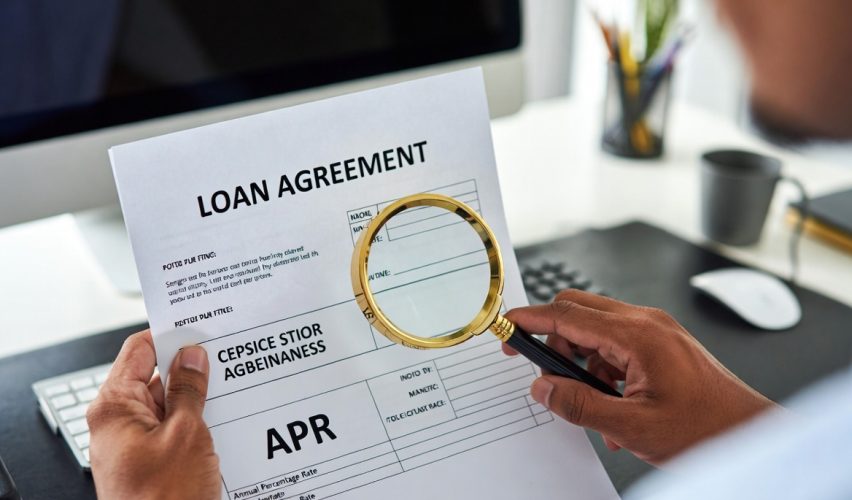
APR stands for Annual Percentage Rate, and it is the single most important number to understand when borrowing money. A 2 percent difference in APR can mean paying $5,000 to $50,000 more over the life of a loan — depending on the amount borrowed. Here is what you need to know.
What APR Actually Means
The APR is the total yearly cost of borrowing money, expressed as a percentage. It includes not just the interest rate but also certain fees and charges associated with the loan. This makes APR a more comprehensive measure of borrowing cost than the interest rate alone.
For example, two mortgage lenders might both quote a 6.5 percent interest rate. But Lender A charges $3,000 in origination fees while Lender B charges $1,500. The APRs will differ — Lender A’s APR might be 6.75 percent while Lender B’s is 6.62 percent — revealing that Lender B is actually the cheaper option despite having the same interest rate.
Think of APR as the “all-in” cost of borrowing. When comparing loan offers, always compare APR to APR — not interest rate to interest rate. This is the comparison that tells you which loan actually costs less over its lifetime.
How APR Affects Your Payments
The impact of APR compounds over time, making it far more significant than most people realize. On a $30,000 car loan at 5 percent APR for 60 months, you pay $3,968 in total interest. At 9 percent APR, that same loan costs $7,380 in interest — nearly double. The monthly payment difference is $57, but the total cost difference is $3,412.
On larger loans like mortgages, the impact is even more dramatic. A $300,000 mortgage at 6 percent APR costs $347,515 in total interest over 30 years. At 7 percent, total interest jumps to $418,527 — a difference of $71,012 for a single percentage point. This is why shopping for the best rate and improving your credit score before applying are so valuable.
Credit cards have the highest APRs of any common borrowing method. The average credit card APR exceeds 20 percent. Carrying a $5,000 balance at 22 percent APR costs $1,100 per year in interest alone. If you make only minimum payments, it takes over 20 years and costs nearly $10,000 in interest to pay off that $5,000.
Fixed vs. Variable APR
Fixed APR stays the same for the life of the loan or credit agreement. Your monthly payment is predictable, and you know exactly what the loan will cost. Mortgages, auto loans, and personal loans typically offer fixed APR options. This is the safer choice for most borrowers because you are protected against rising interest rates.
Variable APR changes based on an underlying index rate (usually the prime rate, which follows the Federal Reserve’s rate decisions). When rates rise, your APR rises and your payments increase. When rates fall, your APR falls. Credit cards almost always have variable APR, and some personal loans and HELOCs (Home Equity Lines of Credit) are variable.
Variable APR loans can be cheaper initially — they often start with lower rates than fixed alternatives. But they carry risk. A variable rate mortgage that starts at 5 percent could rise to 8 percent if the Federal Reserve raises rates aggressively. On a $300,000 mortgage, that increases your monthly payment by over $600.
- Fixed APR — predictable payments, no rate risk, typically slightly higher initial rate
- Variable APR — lower starting rate, potential increases, tied to market rates
- Promotional 0% APR — temporary (6-21 months), regular rate applies after
- Penalty APR — triggered by late payments, can exceed 29%
- Cash advance APR — higher than purchase APR, no grace period
The Credit Card APR Trap
Credit cards have a grace period — typically 21 to 25 days after your statement closes — during which no interest accrues on purchases if you pay your full balance. This is how responsible credit card users get rewards without ever paying interest. But the moment you carry a balance past the grace period, interest starts accruing on everything, and it compounds daily.
Daily compounding is what makes credit card debt so expensive. At 22 percent APR, the daily rate is about 0.06 percent. That might sound small, but it compounds every single day on your entire balance. A $5,000 balance grows by about $100 per month in interest alone. Your $100 minimum payment barely covers the interest, leaving the principal almost untouched.
Penalty APR is another trap. If you miss a payment or pay late, many issuers impose a penalty rate of 29.99 percent — the maximum legally allowed. This rate can apply to your entire existing balance, not just new purchases, and some issuers keep it in place for six months or longer before reviewing your account. One late payment can cost hundreds of dollars in additional interest.
How to check your current APR: Look at your credit card statement — APR is listed in the “Interest Charge Calculation” section. For loans, check your original loan agreement or log into your servicer’s website. Know these numbers. If your credit card APR is above 20% and you carry a balance, explore balance transfer options or personal loan consolidation at lower rates.
APR vs. APY: Know the Difference
APR (Annual Percentage Rate) applies to borrowing. APY (Annual Percentage Yield) applies to earning. When you see a savings account advertised at “4.5% APY,” that is the rate you earn on deposits, including compound interest. When you see a loan at “6% APR,” that is the rate you pay on borrowed money.
The key difference is compounding. APY includes the effect of compound interest, so it is always equal to or higher than the stated interest rate. APR typically does not include compounding effects, which is why the true cost of a loan is often slightly higher than the APR suggests, especially for credit cards that compound daily.
When saving, you want the highest APY. When borrowing, you want the lowest APR. Never confuse the two, and be wary of any financial product that obscures which one it is quoting.
How to Get a Lower APR
Improve your credit score. APR is heavily influenced by your creditworthiness. Borrowers with scores above 740 consistently receive the best rates across all loan types. Improving from a 650 to a 740 could reduce your mortgage rate by 1 percent or more — saving tens of thousands over the loan’s life.
Shop multiple lenders. Rates vary significantly between lenders for the same borrower profile. Getting five mortgage quotes instead of one can save $5,000 or more over the life of the loan. For auto loans, credit unions typically offer 1 to 2 percent lower rates than dealership financing.
Negotiate with your current lender. If you have good payment history, call your credit card issuer and ask for a lower rate. Say: “I have been a customer for X years with no late payments. I am considering transferring my balance to a lower-rate card. Can you reduce my APR?” About 70 percent of people who ask receive some reduction.
Consider shorter loan terms. A 15-year mortgage has a lower rate than a 30-year (typically 0.5 to 0.75 percent less). A 36-month auto loan has a lower rate than a 72-month loan. The trade-off is higher monthly payments, but the total interest savings are enormous.
Check the APR on every credit card and loan you currently have
Know your rates, prioritize paying off the highest-APR debt first, and shop for better rates if your credit has improved.
Finance Helper Hub may receive compensation when you click links on this page. All information is for educational purposes only and does not constitute financial, legal, or tax advice. Consult a qualified professional before making financial decisions.

Get Free Financial Tips Delivered to Your Inbox
Join thousands of readers learning to take control of their money. No spam, unsubscribe anytime.
We respect your privacy. Read our Privacy Policy.