
A new car loses 20 percent of its value the moment you drive it off the lot. Buying a quality used car — and knowing how to negotiate — can save you $10,000 to $20,000 compared to buying new, without sacrificing reliability or features.
The Sweet Spot: 2 to 4 Years Old
The best value in used cars is typically two to four years old with 25,000 to 50,000 miles. These cars have already taken their biggest depreciation hit (30 to 40 percent of original price) but still have plenty of life left. Modern cars routinely last 200,000 miles or more with proper maintenance.
A car that cost $35,000 new in 2022 might sell for $22,000 to $25,000 in 2026 — a savings of $10,000 to $13,000 for a vehicle that is functionally identical to a new one. It likely still has the same technology, safety features, and warranty coverage (or can be covered by an extended warranty) as a new model.
Certified Pre-Owned (CPO) vehicles from the manufacturer’s dealership offer a middle ground. They come with extended warranties, have passed multi-point inspections, and offer some of the peace of mind of buying new at a used car price. CPO vehicles cost $1,000 to $3,000 more than comparable non-certified used cars but include valuable warranty coverage.
Research Before You Shop
Never walk into a dealership without research. Knowledge is your most powerful negotiating tool. Before you visit a single lot, know the fair market value of the specific make, model, year, and trim you want.
Kelley Blue Book (kbb.com) and Edmunds (edmunds.com) provide fair market values based on condition, mileage, and your location. These are the prices you should be targeting. Dealers know these numbers — you should too.
Research the specific model’s reliability ratings on Consumer Reports and J.D. Power. Some models have known issues that make them poor used car choices. Others have excellent long-term reliability records. Honda Civic, Toyota Camry, Mazda3, and Subaru Outback consistently rank among the most reliable used vehicles.
Check recall history on the NHTSA website (nhtsa.gov/recalls). Outstanding recalls should be fixed for free by the manufacturer, but some used cars are sold with unaddressed recalls. Know what to look for.
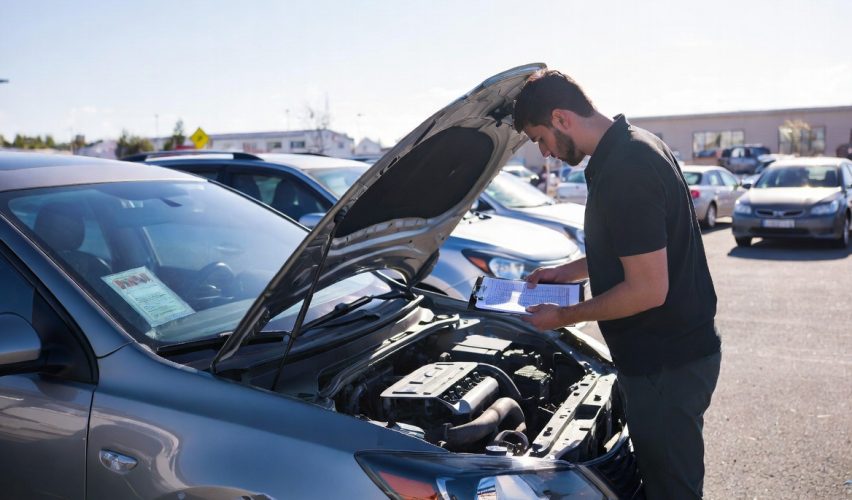
The Pre-Purchase Inspection Is Non-Negotiable
- Always get an independent pre-purchase inspection ($100-200) — never skip this
- Run a vehicle history report (Carfax or AutoCheck) to check for accidents, title issues
- Check for flood damage: musty smell, water stains under carpets, mismatched interior parts
- Look for uneven panel gaps and paint color differences — signs of accident repair
- Test drive at highway speeds and listen for unusual noises
- Check all electronics: AC, heat, windows, infotainment, backup camera
- Inspect tires for uneven wear — indicates alignment or suspension issues
A pre-purchase inspection by your own mechanic (not the seller’s) costs $100 to $200 and can save you thousands by catching hidden problems. If a seller refuses to allow an independent inspection, walk away immediately. No legitimate seller has a reason to refuse.
Negotiating the Price
Start below fair market value. If the fair market value is $18,000 and the dealer is asking $20,000, offer $16,500. They will counter, you will counter, and you will likely settle around $17,500 to $18,500. Starting low gives you room to negotiate up while still landing at a fair price.
Focus on the total price, not the monthly payment. Dealers love to negotiate in monthly payments because they can hide costs in longer loan terms. A $300 per month payment sounds similar whether it is for 48 months ($14,400 total) or 72 months ($21,600 total). Always negotiate the out-the-door price first, then arrange financing.
Get pre-approved for financing. Before visiting dealerships, get pre-approved for an auto loan from your bank or credit union. This gives you a baseline interest rate to compare against dealer financing and shows the dealer you are a serious, informed buyer. Credit unions typically offer the best auto loan rates.
Be willing to walk away. The most powerful negotiating tool is your willingness to leave. There is always another car. If the dealer will not meet a fair price, thank them for their time and walk out. More often than not, they will call you within a day or two with a better offer.
Beware of dealer add-ons. After you agree on a price, the finance office will try to sell you fabric protection ($300-500), paint protection ($500-1,000), VIN etching ($200-300), nitrogen-filled tires ($100-200), and extended warranties ($1,000-3,000). Most of these are overpriced or unnecessary. Fabric protection is a $10 can of Scotchgard. Paint protection is a $50 wax job. Decline everything except possibly an extended warranty, and even then, research aftermarket warranty prices first.
Private Party vs. Dealer
Buying from a private seller is typically 10 to 20 percent cheaper than a dealer because you are not paying for the dealer’s overhead, profit margin, and reconditioning costs. On a $15,000 car, that is $1,500 to $3,000 in savings.
However, private sales have downsides: no warranty, less legal recourse if problems arise, and you need to handle the title transfer and registration yourself. Private sales are best for mechanically savvy buyers or those who have a trusted mechanic do the pre-purchase inspection.
Dealers offer convenience: financing on-site, trade-in processing, warranty options, and they handle all paperwork. For buyers who want simplicity and some protection, paying the dealer premium may be worth it. Just negotiate the price aggressively.
Avoiding Common Used Car Scams
Odometer rollback: Though less common with digital odometers, it still happens. Compare the mileage on the vehicle history report to the current odometer. Look for wear patterns inconsistent with the stated mileage — a car with 30,000 miles should not have a worn-out steering wheel and pedals.
Title washing: Flood-damaged or salvage-title cars are sometimes titled in a different state to remove the brand. Always run a vehicle history report and check the title carefully for any brands or notations.
Curbstoning: Unlicensed dealers posing as private sellers to avoid consumer protection laws. Red flags include vague answers about the car’s history, a seller who cannot show you service records, and a different name on the title than the person selling the car.
Pressure tactics: “Someone else is looking at it today” or “This price is only good right now” are classic high-pressure tactics. A good deal will still be a good deal tomorrow. Never let urgency override due diligence.
Research fair market values before you start shopping
Know the price, get pre-approved financing, and always get an independent inspection before signing anything.
Finance Helper Hub may receive compensation when you click links on this page. All information is for educational purposes only and does not constitute financial, legal, or tax advice. Consult a qualified professional before making financial decisions.

Get Free Financial Tips Delivered to Your Inbox
Join thousands of readers learning to take control of their money. No spam, unsubscribe anytime.
We respect your privacy. Read our Privacy Policy.